HAYWARDS HEATH, WEST SUSSEX, 11 November 2026. On Armistice Day, as the country pauses to remember those who have served, Phoenix Marketing is putting its full support behind the British companies that equip and protect our armed forces. The agency, based in Haywards Heath, believes the UK has reached a genuine moment of opportunity for its defence suppliers, and that thoughtful defence marketing is one of the simplest ways to turn that opportunity into contracts, jobs and capability.
“I believe we all need to be doing more to secure the defence of our country. Phoenix is fully behind any initiative that supports UK industry, and we want to help British defence companies be found, trusted and chosen.”
Stuart Farrell-Humphrey, founder, Phoenix Marketing
A defence sector the whole country can be proud of
The numbers behind British defence are encouraging. New figures from trade association ADS show that the UK’s aerospace, defence, security and space sectors added £46.8 billion to the economy in 2025, a 65% increase over the past decade. Those sectors now directly employ 468,500 people, up by nearly 40% since 2015.
Within that total, the defence sector alone recorded turnover of £36.5 billion and employs 189,500 people. ADS chief executive Kevin Craven described these industries as “the industrial foundation on which our nations rely upon”, a view that is hard to argue with. Defence exports reached £10.8 billion in 2025, and earlier ADS analysis found that around 80% of defence jobs are located outside the South East, which means this is a story of opportunity for towns and regions across the whole UK. Defence jobs also tend to pay well: Deloitte, drawing on ADS data, notes that wages in the sector average around 12% above the UK norm.
Record investment, and a real opportunity for British firms
The government has committed to the largest sustained rise in defence spending since the Cold War. Announcing the Defence Industrial Strategy in September 2025, Defence Procurement Minister Luke Pollard said the plan rests on “the largest sustained increase in defence spending since the end of the cold war”, with spending set to reach 2.6% of GDP by 2027 and 3.5% by 2035, alongside NATO allies. A further 1.5% of GDP is planned for resilience and security, taking the overall ambition to 5%.
The Strategic Defence Review, published in June 2025, set the tone. Defence Secretary John Healey said it reflects a “new era of threat, which demands a new era for UK Defence”. For industry, the practical message is encouraging: ADS analysis suggests the defence workforce could grow by around 50,000 people by 2035 as spending rises, and the Defence Industrial Strategy explicitly promises to prioritise UK based businesses.
Why defence marketing matters for smaller suppliers
Small and medium sized firms are central to this picture, and the government has said so clearly. In 2023 to 2024, only around 4% of defence spending went to SMEs. The new strategy aims to raise MoD spending with small businesses by 50%, or £2.5 billion, by 2028, supported by a Defence Office for Small Business Growth. At least 10% of the MoD’s equipment procurement budget is also being directed to novel technologies, and a new £400 million UK Defence Innovation fund will invest in growing British companies.
The evidence that this support works is already there. The Defence and Security Accelerator has backed 461 UK SMEs since 2016, and its funding has been followed by nearly £600 million of private investment and 1,842 new jobs. Initiatives such as the free Hellios SME portal, created with JOSCAR, exist for one simple reason: to improve the visibility of smaller companies to buyers across defence, aerospace and security.
That word, visibility, is where defence marketing comes in. Procurement teams, prime contractors, investors and prospective employees all begin their research online. A capable British supplier that cannot be found, or whose website does not explain clearly what it does, can miss out on conversations that its products deserve to win. Good marketing gives an excellent business the chance to be judged on its merits.
What good defence marketing looks like
Defence marketing is not about shouting louder. It is about being clear, credible and discoverable, while respecting the security, export control and confidentiality that this sector rightly takes seriously. In practice, the agency recommends five foundations:
- Clear capability pages that explain, in plain language, what a company makes, certifies and delivers, without disclosing anything sensitive.
- Search engine optimisation and generative engine optimisation, so that buyers using Google or AI assistants find accurate information about your business.
- Evidence and case studies, shared only where permitted, that show reliability, quality standards and a record of delivery.
- Visibility within trade bodies, regional defence and security clusters and supplier portals, supported by thoughtful digital PR.
- Recruitment marketing, so that employers can attract the engineers, technicians and apprentices that growth of this scale will require.
Trust is the currency of this market. Primes and procurement teams look for evidence of compliance, accreditations and resilience, so the best defence marketing is accurate before it is persuasive, with every claim checked carefully alongside the client.
There is a people dimension too. If the sector grows as ADS expects, thousands of new engineers, technicians and apprentices will be needed, and they will research employers in the same way buyers research suppliers: online. Clear careers pages and honest stories about the work help a British firm compete for talent as well as for contracts.
The MoD lists regional defence and security clusters from Lincolnshire to the North East, which shows how much of this activity happens close to home. Wherever a firm is based, the same principle applies: be visible where buyers and partners look.
Phoenix Marketing, which covers SEO, GEO, PPC, content, digital PR and video, will be applying exactly this practical, measured approach to support UK defence businesses that want to grow.
Supporting UK industry, today and tomorrow
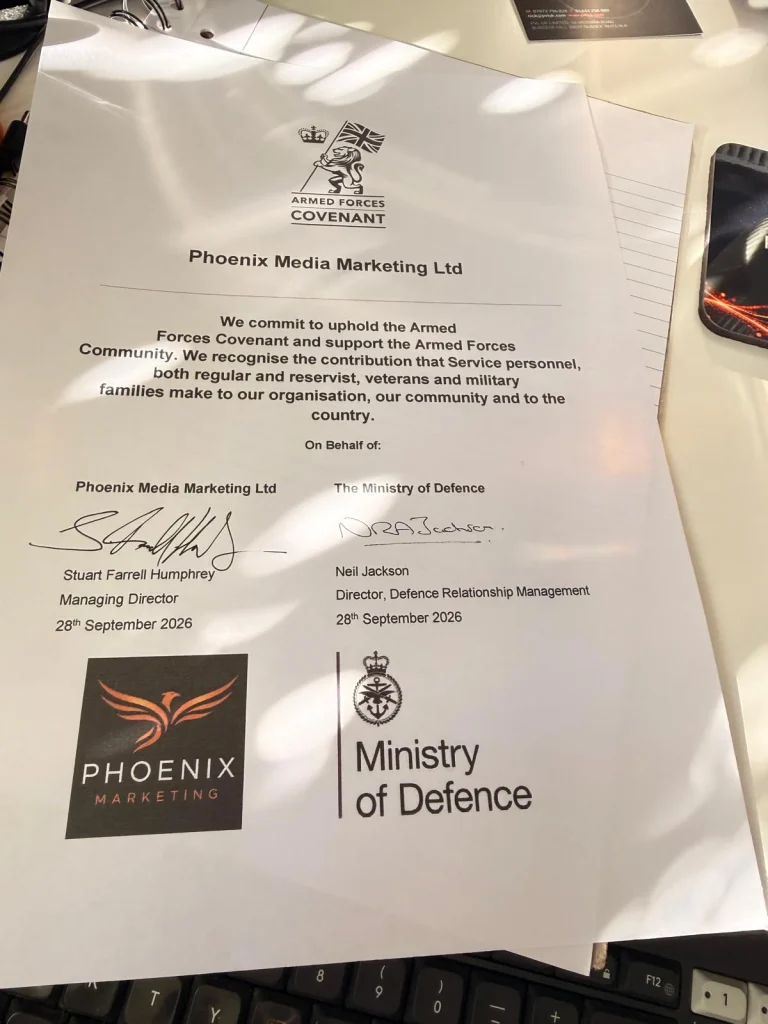
The agency’s commitment is straightforward. It wants the companies that strengthen Britain’s security to be easy to find, easy to trust and easy to work with, whether they are long established primes or ambitious firms still winning their first MoD contract. Phoenix Marketing has also signed the Armed Forces Covenant.
Our part is a modest one, but we believe that every business can contribute to national resilience. For a marketing agency, that means helping good British companies tell their story with confidence, clarity and care.
“Every pound spent with a British supplier supports skilled jobs, local communities and national resilience. If good marketing helps one more UK company win that work, it is time well spent.”
Stuart Farrell-Humphrey, founder, Phoenix Marketing
Defence suppliers, manufacturers and supply chain businesses that would like a friendly, no obligation review of how they appear online can contact the team on 01444 523105 or at stuart@phoenixmarketing.uk.
About Phoenix Marketing: Phoenix Marketing is a full service marketing agency based at 49 Edward Road, Haywards Heath, West Sussex RH16 4QJ, founded in 2020. The agency helps UK businesses grow through SEO, GEO (generative engine optimisation), PPC, content, digital PR, social media and video. Telephone 01444 523105. Website phoenixmarketing.uk.
Sources
- ADS, aerospace, defence, security and space value to the UK
- UK Defence Journal, ADS Facts and Figures 2026
- The Manufacturer, defence exports in 2025
- ADS, increased defence spending could deliver 50,000 jobs by 2035
- Deloitte, addressing the defence skills gap
- Luke Pollard MP, statement on the Defence Industrial Strategy
- Defence Industrial Strategy 2025 (GOV.UK)
- Pinsent Masons, defence drive and the 5% commitment
- UK Defence Journal, Strategic Defence Review 2025 published
- ADS, SMEs set to benefit from the defence investment boost
- Gowling WLG, Defence Industrial Strategy 2025
- British Chambers of Commerce, Strategic Defence Review briefing
- Defence Online, DASA growth impact
- GOV.UK, Procurement at MOD