Why traditional SEO alone is no longer enough in 2026
By Stuart Humphrey
Founder
Phoenix Media Marketing
Q1 2026
Every few years, something happens in marketing that genuinely changes the rules. Mobile was one. Programmatic was another. And right now, in front of us, AI search is doing the same thing, only faster, and with less warning.
I’ve spent the first quarter of 2026 head down in the data here at Phoenix Marketing HQ, looking at how people are actually finding businesses online today versus 12 months ago. The numbers are clear enough that I want to put a marker in the ground: if you’re an SMB owner or marketer and you’re still planning your year around Google and PPC alone, you are already behind.
This isn’t a doom piece. There’s a huge opportunity in this, but only for businesses that move now. Here’s what’s actually happening, what it means for you, and what we at Phoenix are doing about it for our clients.
I looked at search data from Google, ChatGPT, Gemini, Perplexity, and Claude because my curiosity was simple: how is each platform faring in market share when individuals are deciding how they search for information online.
As an agency owner, I ask my team each week how we can evolve and offer better value for our clients retainers and they point me back to research as research is something that often goes overlooked in marketing, it can be seen as an additional cost, yet right now the search landscaope is evolving so fast, we have to examine the statistics even more so than ever, so that we can understand and keep ahead of sesmic shifts in the digital landscape, wich is literally happening before our eyes.

The headline numbers (Jan – March 2026)
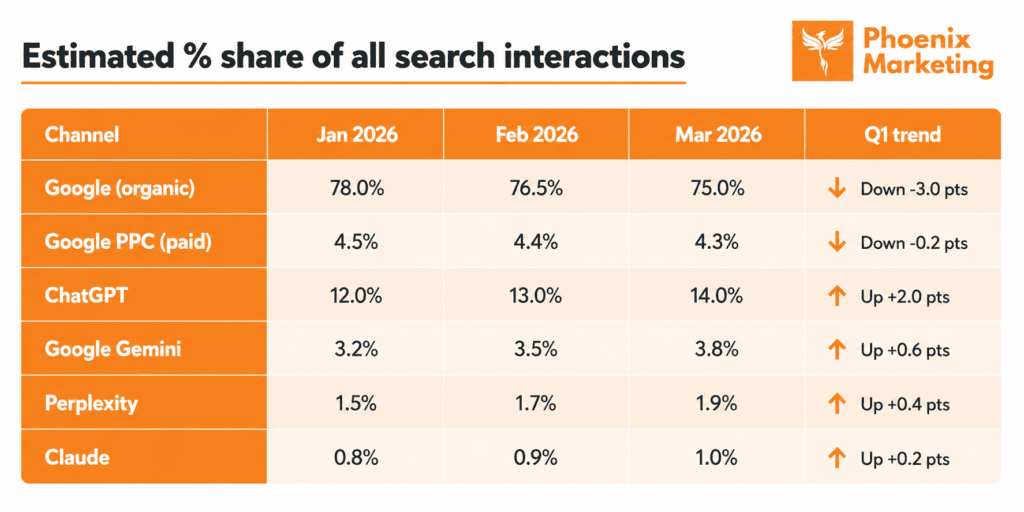
Across Q1 2026, Google still dominates total search volume, but its share is visibly eroding while AI assistants are picking up that ground at pace. Pulling together data from First Page Sage, Similarweb, StatCounter, Ahrefs and Datos, this is roughly what the search landscape looks like right now
- Google (organic): 78% in January, 75% by end of March a 3-percentage point slide in 90 days.
- Google PPC (paid search): essentially flat at 4.3 -4.5%, with a marginal decline as AI Overviews compress click-through on commercial queries [6].
- ChatGPT: 12% → 14% of all search-style interactions. ChatGPT Search alone is now handling 250 -500 million weekly queries [3].
- Google Gemini: 3.2% → 3.8% — the fastest-growing challenger inside Google’s own ecosystem [2].
- Perplexity: 1.5% → 1.9% – small base, but 370% growth year-on-year [2].
- Claude (Anthropic): 0.8% → 1.0% – Claude.ai traffic grew from 220M visits in January to 614M by March [7].
Put another way: roughly one in five “searches” in early 2026 is now happening somewhere other than a traditional search engine. Twelve months ago that number was comfortably in the low teens [1][2]. That is not a slow drift. That is a re-platforming. Of which the growth really did make me think how fast AI is dominating the search landscape.
So what's really going on?
Three things are happening at once, and they reinforce each other and as they say the devil is in the detail on the next set of metrics.
First, behaviour has changed. People aren’t just typing two-word phrases into a box anymore. They’re asking full questions “what’s the best CRM for a 12-person agency in the UK that integrates with Xero?” and they’re expecting an answer, not a list of ten blue links to read themselves.
AI assistants are simply a better fit for that behaviour. Ahrefs reported in early 2026 that ChatGPT now has roughly 12% of Google’s search volume but sends 190x less traffic to websites because users get the answer inside the chat [4].
Second, Google is responding by becoming more AI-like itself. AI Overviews those AI-generated summaries at the top of the results page appeared on around 25% of Google searches by March 2026, up from 13% a year earlier [8]. Where they appear, paid CTR drops from around 21% to under 10% [6]. So even “normal” Google searches are starting to feel like AI searches.
Third, the AI assistants themselves are diverging into specialists. ChatGPT is the default. Gemini is the Google-native one. Perplexity is becoming the research and citation engine of choice. Claude is being adopted heavily inside businesses for longer, more considered work. That matters, because it means your customers aren’t all in one place anymore, they’re spread across four or five answer engines, each with its own ranking logic [1][2][9].
Why this hits SMBs harder than enterprise
Big brands have brand. If someone asks ChatGPT “what’s the best running shoe?” Nike and Asics are going to come up because they’re already structurally embedded in the training data and across the web.
If you’re a small or mid-sized business, you don’t have that gravitational pull. You rely on showing up at the moment of intent the search. And the moment of intent is moving. Informational query traffic to content sites is already down 15–30% in the categories AI assistants do well in [8]. If your business depends on “someone Googles us, lands on our site, fills in the form,” that funnel is being quietly shortened and sometimes deleted entirely by whoever ChatGPT recommends instead of you.
The flip side: this is one of those rare moments where being small is an advantage. You can adapt in weeks. A FTSE 100 brand can’t. We see many companies now reviewing their previous SEO agreed strategies as these are becoming fast redundant.

The three lanes you now have to budget for: SEO, PPC, and GEO
For the last fifteen years, digital marketing budgets have run on two engines: SEO (earn the click) and PPC (buy the click). I’d argue from this quarter onwards there’s a third lane, and you ignore it at your peril: GEO Generative Engine Optimisation. It’s the discipline of getting your business cited, recommended and surfaced inside AI answers.
GEO isn’t a rebranded SEO. It uses different signals. Structured information, clarity of claims, third-party citations, presence on the sources that LLMs actually trust, and increasingly direct ingestion into platforms like ChatGPT’s web index and Perplexity’s source set. Early adopters who tested AI search advertising are already reporting 2.4x higher engagement rates than traditional search ads [6].
Here’s how I’d think about the split going into the back half of 2026:
- SEO is still essential. Google organic is 75% of the search universe. Don’t drop it; just stop assuming it grows.
- PPC still profitable but be ruthless. Where AI Overviews appear on your money keywords, your CTR is halving. Re-test, re-bid, re-creative.
- GEO start now, even if you start small. Track citations in ChatGPT, Gemini, Perplexity and Claude for your top 20 commercial queries. Most SMBs are not yet doing this. That’s the gap.
What we're telling Phoenix clients to do this quarter
If I had to compress 90 days of analysis into five practical moves, this is the list I’d put on the wall of any SMB right now:
- Audit how you currently appear in AI answers. Ask ChatGPT, Gemini, Perplexity and Claude the questions your customers ask. Note who comes up. If it isn’t you, that’s the work.
- Get your facts ingestible. Clear pricing, clear service definitions, clear locations, clear FAQs, in plain language on your own domain. LLMs reward unambiguous content.
- Earn third-party citations. The single strongest signal we see for being recommended by AI is being referenced by sources the model already trusts trade press, directories, comparison sites, podcasts with transcripts.
- Don’t abandon PPC recalibrate it. Identify the queries where AI Overviews now appear, expect lower CTR there, and shift budget toward queries where they don’t (yet).
- Measure differently. “Sessions from Google” is no longer the only KPI. Add: “share of voice in AI answers,” “branded query volume” (a good proxy for AI-driven awareness), and “direct/organic-branded traffic.”
My honest take
I don’t think Google is going away. Alphabet’s Q1 2026 search revenue grew 19% year-on-year [10]. The machine is still very much running. But the shape of search is changing under us, and the businesses that win the next three years won’t be the ones with the biggest PPC budget they’ll be the ones who built a presence across all the places their customers now ask questions.
That includes Google. That includes ChatGPT. That includes Gemini, Perplexity and Claude. And, increasingly, it’ll include the AI agents your customers send out on their behalf to shortlist suppliers for them.
The good news is that the playbook isn’t a mystery. The signals are knowable. The work is doable. You just have to start. Perhaps some direct questions to your agency now on how they are adopting the rise in AI driven searches.
Let's talk
If you’d like a second pair of eyes on how your business currently shows up or doesn’t across Google, PPC and the AI assistants, that’s exactly the conversation we’re having with our clients right now. I’m happy to share what we’re seeing across categories and run a short, no-obligation diagnostic on your top queries.
Drop me a line and let’s have a proper conversation about your GEO and AI search strategy. The earlier you start, the cheaper the lesson.
Founder, Phoenix Media Marketing
References
[1] First Page Sage — Google vs ChatGPT Market Share: 2026 Report. https://firstpagesage.com/seo-blog/google-vs-chatgpt-market-share-report/
[2] Stackmatix — AI Search Market Share 2026: ChatGPT, Gemini & Perplexity (March Update). https://www.stackmatix.com/blog/ai-search-market-share-2026
[3] Digital Applied — AI Search Engine Statistics 2026: Market Share Data. https://www.digitalapplied.com/blog/ai-search-engine-statistics-2026-market-share
[4] Ahrefs — ChatGPT Has 12% of Google’s Search Volume but Google Sends 190x More Traffic. https://ahrefs.com/blog/chatgpt-has-12-percent-of-googles-search-volume/
[5] PPC Land — AI still under 2% but growing: Datos Q1 2026 state of search report. https://ppc.land/ai-still-under-2-but-growing-datos-q1-2026-state-of-search-report/
[6] Demand Local — 2026 AI Overview Presence and Paid Search CPC Statistics. https://www.demandlocal.com/blog/presence-and-paid-search-cpc-statistics/
[7] Backlinko — Claude Statistics 2026: How Many People Use Claude?. https://backlinko.com/claude-users
[8] Position Digital — 150+ AI SEO Statistics for 2026 (Updated April). https://www.position.digital/blog/ai-seo-statistics/
[9] upGrowth — AI Traffic Share Report 2026: ChatGPT, Perplexity & AI Overviews Data. https://upgrowth.in/ai-traffic-share-report-2026/
[10] PPC Land — Alphabet Q1 2026: Google Network ad revenue falls 4% as AI reshapes the web. https://ppc.land/alphabet-q1-2026-google-network-ad-revenue-falls-4-as-ai-reshapes-the-web/

Why West Sussex Businesses Are Choosing Independent Marketing Agencies Over London
If you’re a business owner in West Sussex, you’ve probably been approached by a London agency at some point. Slick deck, impressive client logos, eye-watering retainer fee. But if you’ve ever actually worked with one, you’ll know what often follows. A junior account manager you never speak to, templated strategies that could apply to anyone, and a bill that doesn’t reflect the results.

The AI Search Shift Is Already Here and Your Customers Are Already Using It
Every few years something happens in marketing that genuinely changes the rules. Mobile was one. Programmatic was another. And right now, in front of us, AI search is doing the same thing only faster, and with less warning. I’ve spent the first quarter of 2026 head-down in the data here at Phoenix Marketing HQ, looking at how people are actually finding businesses online today versus twelve months ago.
The Google March 2026 core update is now complete. Here’s what it means for local and medium-sized businesses.
Google confirmed the March 2026 Core Update was fully rolled out on 8th April. If you’ve noticed changes in your traffic, leads, or online presence recently, you’re not alone. If your traffic has dropped and you want to know why, here’s what changed, why local and mid-sized businesses are most affected, and how Phoenix Marketing has responded to help our clients succeed.
Why so many UK Businesses waste money on marketing agencies and how to choose one that actually delivers
A candid view from inside the industry, written for owners turning over £200,000 to £2,000,000 who are tired of being sold to.

How AI Marketing Is Helping Businesses Grow (And Why You Still Need a Human Behind the Wheel)
If you’re a business owner reading this and you haven’t yet thought seriously about how AI marketing can accelerate your growth, the window to get ahead of your competitors is closing.

Phoenix Media Marketing Joins the Sussex Cancer Fund Business Charity League
Phoenix Media Marketing is proud to be competing in the Sussex Cancer Fund Business Charity League, a high energy fundraising competition bringing together ambitious Sussex companies to raise money.