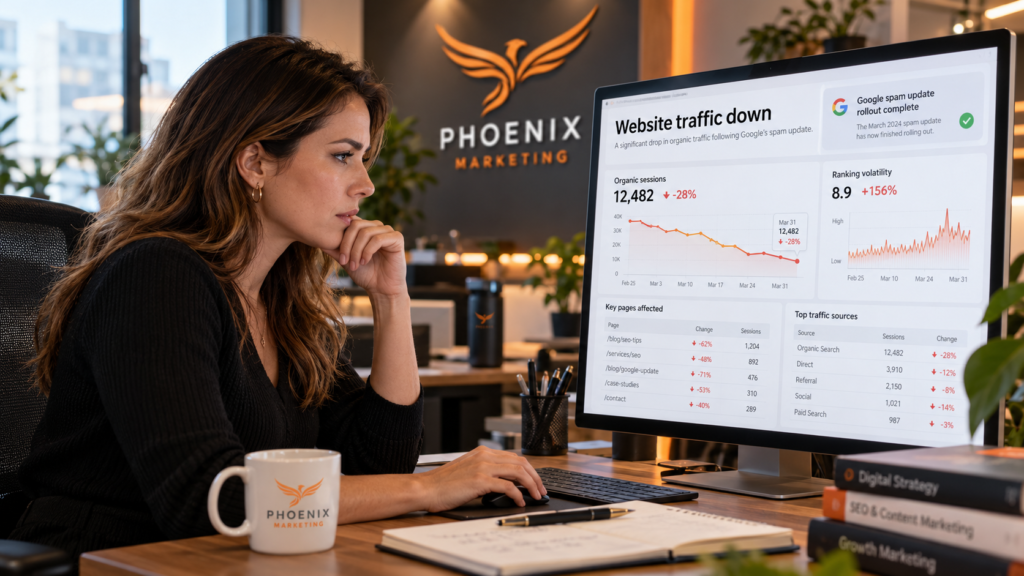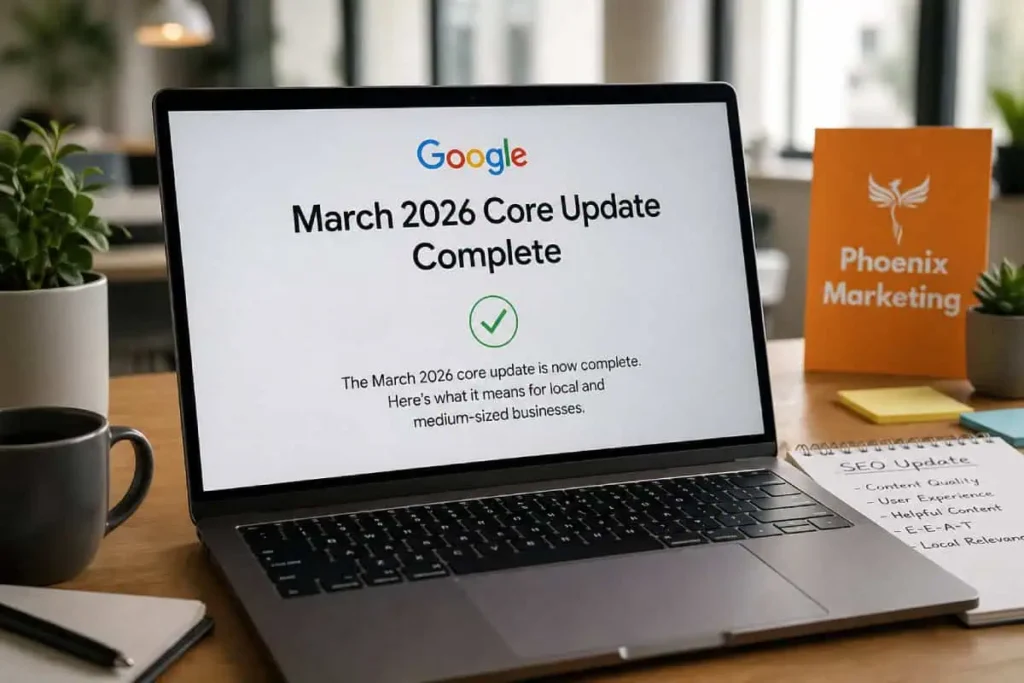
Google confirmed the March 2026 Core Update was fully rolled out on 8th April. If you’ve noticed changes in your traffic, leads, or online presence recently, you’re not alone. If your traffic has dropped and you want to know why, here’s what changed, why local and mid-sized businesses are most affected, and how Phoenix Marketing has responded to help our clients succeed.
By the Phoenix Digital Marketing Team
We know that here at Phoenix, Google core updates always change the search landscape, but the March 2026 update, which finished rolling out around 8th April, has been especially significant. Local businesses and medium-sized companies that depend on organic search for steady leads have felt it most.
At Phoenix, we’ve tracked the update closely from the start, watching how rankings shifted for our clients and modifying our strategies when necessary. In this article, we’ll explain in clear terms what happened, what it means for your business, and how Phoenix is responding.
If you own a local business or manage marketing at a medium-sized company, you should discuss this update with your digital marketing team. If you’re not, that’s a concern, and we’ll discuss why later.
What the March 2026 Core Update Actually Is
Google releases several major core algorithm updates each year. These aren’t minor fixes; they’re big changes in how Google judges the relevance, trustworthiness, and usefulness of every page. The March 2026 Core Update started in the last week of March and finished on 8th April. During the 14-day rollout, we saw some of the largest ranking changes in 2 years, especially in the last 3 days. (Southern, 2026)
This update centres on three main themes, which will shape what appears on page one for the rest of the year:
1. A sharper line on E-E-A-T and demonstrable expertise
Google is putting even more weight on Experience, Expertise, Authoritativeness, and Trust. Pages that show real experience, such as those with named authors, verified credentials, original photos, first-hand examples, and verified business details, are being rewarded. Generic, AI-generated pages without an individual touch are being pushed down, even when they look well-written. Using your own photos instead of stock images can help build trust with Google.
2. A heavier weighting toward genuine local relevance
For local searches, Google now relies more on hard-to-fake signals, such as your business’s location, consistent contact details, active Google Business Profile updates, local reviews, and content aimed at a specific area. Generic list articles on broad sites don’t work anymore. If your competitor is truly connected to the local community, they’ll outrank you even if their website is smaller. That’s why joining local groups, like the Haywards Heath Business Association, can really help your online presence.
3. A review of “helpful content” at the page level
The signals previously associated with the Helpful Content System are now baked into core ranking. (Southern, 2026) That means thin, duplicative or template-driven service pages, the sort that many agencies still mass-produce for their clients, are being marked down individually, not site-wide. A lone weak page can drag the rest of your site’s topical authority with it. (Team, 2026) Think about making your pages unique, and if agencies (Forrester, 2026) offer a FREE website design service, it’s potentially worth stepping aside, as the chance it will rank effectively in the future is very slim.
Stuart, our MD at the Phoenix, commented:
“If your website was set up to satisfy a checklist instead of a customer, the March 2026 Core Update will have noticed.”
Why local and medium-sized businesses felt it most
Big brands have in-house SEO teams, data experts, and content creators. They can manage updates, shift resources, and recover quickly.
The businesses most affected by this update are those in the middle: local independents, regional service providers, and mid-sized firms with a marketing manager and an agency. We know this firsthand, as we’ve felt the pressure too. Here are three reasons why this group has been hit hardest:
- Many local sites still rely on duplicated or templated location pages, a “growth hack” that has been quietly punished for years and is now being aggressively penalised.
- Medium-sized businesses often have older content, filled with blog posts focused on keyword density instead of what users need. These pages no longer meet Google’s new helpfulness standards. They won’t perform well after this update.
- Smaller agencies and freelancers often haven’t had the bandwidth to retrofit E-E-A-T signals such as named expert authors, schema markup, original case studies and photographs, and signed-off review responses.
Stuart mentions
“Between late March and 8th April, a significant share of mid-market websites saw double-digit percentage drops in organic visibility for their highest-converting commercial keywords. (Team, 2026)
Some businesses lost all their local pack visibility. Many still don’t realise it, either because their reports only update weekly or their agency hasn’t informed them. (Forrester, 2026)”
A Direct Question for Anyone Reading This
Has your current agency actually told you about the March 2026 Core Update?
Not just a standard monthly report or a screenshot of a vanity metric. You need a real, straightforward conversation about whether your traffic changed between 25th March and 8th April, why it happened, and what your agency is doing about it now.
If your answer is “no,” “sort of,” or “they mentioned it but didn’t share data,” that tells you how much strategic attention your account is getting.
Core updates are the biggest events in organic search. Not informing clients about a confirmed Google update is, in our view, a basic failure of responsibility.
What a real update briefing looks like
Stuart summarised this as
“At Phoenix, year-on-year and week-on-week organic traffic, ranking deltas for your top 25 commercial keywords, GBP visibility changes, a hypothesis about why, and a specific plan with named actions and dates. Anything less is theatre. Which isn't what you are paying for.”
How Phoenix Marketing adapted. Before, during and after the roll-out
We don’t see core updates as surprises. While the details may change, we know they’re coming. Phoenix has an ongoing core update readiness program for every client, and the March 2026 update was the latest test of our process. Here’s what we did:
Before the roll-out: pre-emptive content auditing
Starting in mid-February, our team audited all client content for thin, duplicate, or AI-generated pages. We rewrote, combined, or removed about 18% of indexable URLs. The pages we kept got an E-E-A-T boost: named authors, credentials, real photos, original data, and clear first-hand experience. We now review each client’s SEO needs every month and match our work with their overall strategy.
During the roll-out: live monitoring and triage
As soon as Google announced the update, we checked rankings and visibility daily for each client using custom keyword lists. If we saw changes, we responded within 24 hours: we sent a concise update, summarised the impact, and shared an action plan for that week. Clients never had to chase us or ask whether something had changed. We’re always clear about whether results are positive or negative.
After the roll-out: doubling down on what’s now rewarded
Now that the update is complete, we’ve focused our efforts on four areas that the new algorithm rewards most:
- Locally-grounded content production pages which clearly serve a defined geography with original information, not regurgitated facts.
- Actively optimising Google Business Profiles every week, not merely setting them up and leaving them. Also, make sure your video verification is complete if it’s still pending.
- Earning real links through PR-driven digital strategies, instead of relying on directory or exchange links, which are now less effective. Also, keep an eye out for sites linking to you without your approval; you may need to disavow those links.
- Conversion rate optimisation on the pages that are still ranking, so every recovered visit pays for itself.
How Phoenix Marketing pushes traffic to your business in this new landscape
A core update doesn’t just shift rankings, it changes which strategies are effective. Shortcuts are now penalised. The good news is that the strategies that work are the ones that build lasting, reliable visibility for your business. Here’s our updated approach to driving traffic after the update.
1. Local SEO that earns its place in.
We see your Google Business Profile as a living asset. We post weekly, add new photos, answer questions, and respond quickly to reviews. Combined with strong local relevance on your website, this now drives most high-intent local traffic. local traffic.
2. Content engineered for E-E-A-T from day one
For every client, we create commercial pages that follow the new core update guidelines: named expert authors, original viewpoints, first-hand proof, clear experience, schema markup, and links from related authority pages. This approach takes more effort, but it delivers results.
3. Digital PR and earned links that survive future updates
Traffic from cheap links won’t last. We use your budget to earn editorial coverage from publications that matter in your industry and region the kind of coverage Google knows isn’t paid for.
4. Paid media that supports, not props up, organic
We use Google Ads, Microsoft Ads, and paid social to capture high-intent search demand. Paid media isn’t used to cover up weak SEO, it’s used to build on strong SEO. We’ll soon share a case study showing how this approach produced a £1.4 million sales pipeline for a manufacturing client.
5. Measurement that shows, not tells
Every client gets a monthly report focused on metrics that matter for revenue: organic sessions by city, leads by service, Google Business Profile actions, and conversions from paid ads. We note vanity metrics although don’t focus on them. Ranking first isn’t enough you need to look at your share of voice.
How Phoenix Marketing stays on top of Google Updates
Keeping ahead. Keeping ahead of Google isn’t a one-time task it’s an ongoing discipline. We invest in three areas that most agencies at our level don’t: a dedicated algorithm-monitoring rota. Members of our team rotate weekly through volatility tracking, search-engine roundtables, and direct testing on internal sites we own. We learn on our own properties before we ever experiment on a client’s. We conduct tests in the agency weekly and monitor these for uplift.
- A written core-update playbook. Every Phoenix account has a set response plan for the first 24, 72, and 168 hours after a confirmed Google update. We keep this plan up to date and review it every quarter.
- Continuous training and accreditation. Our consultants maintain active accreditations across Google, Microsoft, Meta and the major SEO platforms, and they’re given dedicated weekly hours to read, test and document new findings. That cost is absorbed by us, not passed on.
The result is a digital marketing agency for local businesses and medium-sized companies that doesn’t flinch when Google moves. We’ve been through enough core updates to know that the worst thing an agency can do is wait until the dust settles before starting to think. By then, your competitors have already moved.
If you’ve read this far, you already know what to do next.
If your traffic, leads, or rankings have moved in the last fortnight, request a free post-update visibility audit from Phoenix. We’ll pull your real data, benchmark you against two named competitors, and send you a plain-English summary of what changed, what it means, and what we’d do about it in the first 30 days. No pitch deck. No upsell. Just an honest second opinion from a team that really watches this stuff for a living.
Book your free Phoenix March 2026 Core Update audit.
Email hello@phoenix.agency or call us on the number on our website.
We’ll send you a confidential post-update visibility report within five working days, with no obligation to switch agencies.
Phoenix Marketing is a full-service marketing agency for local businesses and medium-sized companies. SEO, paid media, content and conversion, joined up properly. We’ve doubled in size year after year, investing in local talent to support the local communities we serve.